.png)
You can usually tell within the first ten minutes whether a negotiation workshop is going to be useful or just noisy.
Someone leans back, folds their arms, and says the line they believe is wisdom: “Look, it’s simple. They’ve got the advantage. If you don’t get tough, you lose.” A couple of people nod. Someone else smirks like they’ve heard it all before. And the facilitator can feel the room quietly agreeing to a false choice: be hard or be had.
Here’s the awkward truth: most workplace negotiation isn’t about price.
It’s about priorities, resources, trade-offs, status, and risk. Which means negotiation style shows up everywhere: project meetings, stakeholder reviews, leadership offsites. It’s how decisions get made when interests collide - not just what happens when procurement sends you a spreadsheet.
So when a team turns up “ready to get tough”, they’re not necessarily being difficult. They’re usually being protective. Margins are being lost. Deals are slipping. Someone senior has said, “Stop being so soft.” And now the group has arrived with a story that feels safe: pressure equals strength.
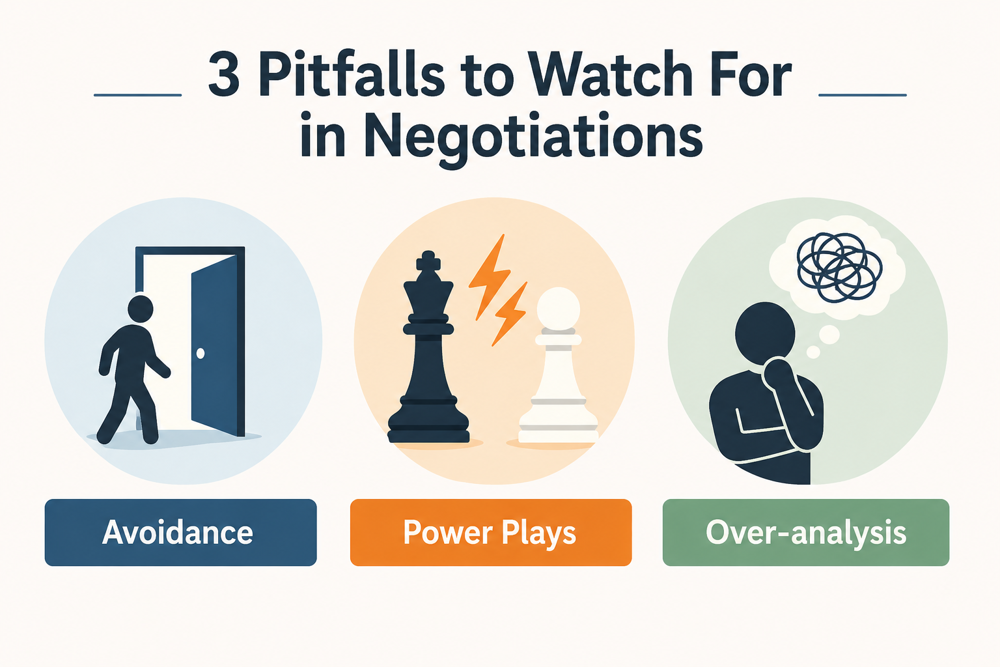
The facilitation challenge is that when interests collide, teams often default to one of three unhelpful moves:
Avoidance (“let’s take it offline”), power plays (“because I said so”), or over-analysis (death by options). “Get tough” is a power play dressed up as professionalism.
It’s a threat response - fight mode - and it often comes with a moral glow: we’re not being nasty, we’re being commercial.
What’s really going on (and why “tough” feels sensible)
Under pressure, people don’t “choose a strategy”; they default to a style. It’s threat response plus identity protection.
- If I push hard, I can’t be pushed around.
- If I show flexibility, I’ll look weak.
- If I ask questions, they’ll think I don’t know my numbers.
- If I trade, I’ll end up conceding.
The problem is “tough” is often just predictable. And predictable is easy to manage.
The other side can wait you out, let you posture, then offer you a tiny concession that feels like a win… while you quietly give away the variables that actually matter. Or they can mirror your toughness, escalate, and suddenly you’re not negotiating - you’re performing.
If you’re facilitating this, your job isn’t to tell them to “be nicer”. You’ll lose them immediately. Your job is to help them see that “tough” is one style, not a personality… and it’s not the only way to protect margin.
The facilitation move: name the pattern without blaming the person
When the “get tough” energy shows up, don’t argue with it. Use it.
Start by validating the intent, then widen the frame:
- “I get it. You want to stop margin leakage.”
- “And if we only have one gear - tough - we’ll be easy to predict.”
- “Let’s diagnose what we default to under pressure, then choose what works.”
This is where a negotiation style profile helps you name the pattern without blaming the person. It takes the heat out of the room. Instead of “you’re aggressive,” it becomes “your default style under pressure is X - and it has strengths and costs.”
And once the team can see their default, you can introduce the more effective option you’re aiming for: create rapport/trust, then trade asymmetrical variables to engineer a win–win.
Not “be friendly”. Not “give in”.
Rapport as a commercial tool: it gets you information, options, and movement.
The phrase (verbatim language you can use)
Here are four lines you can use in the moment, without shaming anyone:
- “I’m not here to take toughness away from you - I’m here to give you more options than one.”
- “If we only know how to push, we’ll miss what we could trade.”
- “Let’s be clear about what matters most to each of us - then we can trade properly.”
- “Our goal isn’t to win the moment. It’s to win the outcome.”
That third line is the reset phrase. It’s the hinge between posturing and progress.
Tool to deploy next week: Negotiating Style Profile
If you want a practical diagnostic that creates movement, not just insight, use the Negotiating Style Profile.
Explore the Negotiating Style Profile here: https://www.mlruk.com/negotiating-style-profile-2