.png)
When a Managers or a Client says, “Communication is poor”, I try not to nod too enthusiastically.
Not because it isn’t true. More because it’s usually the organisational equivalent of saying, “The car won’t start.” Helpful as a headline. Useless as a diagnosis.
Nine times out of ten, “communication is poor” is a polite way of saying something sharper:
→ We didn’t have clarity on the goal.
→ We didn’t make a clear decision.
→ We didn’t name ownership.
→ We didn’t identify the specific risks.
→ We didn’t confirm and align around one message.
→ And now we’re surprised that the delivery looks like a game of Chinese whispers played by tired adults.
If you’re a facilitator, trainer or coach, this is good news. Because you can’t fix communication in the abstract while you can absolutely tighten up on the clarity and decision-making in the room so that communication improves as a side-effect.
Scenario from the room
You’ll know the meeting.
A senior team spends 45 minutes circling a topic. Everyone contributes. Nobody is rude. There’s a lot of “Yes, and…” energy. Someone says, “Great discussion.”
Then the chair lands the plane with a classic British non-decision:
“So… we should probably do something around that.”
People nod. Diaries are checked. The next agenda item arrives.
Two weeks later, nothing has moved. The same topic reappears. Someone sighs and says, “We’ve got a communication issue.”
No. You’ve got a decision-to-delivery issue.
What’s really going on (the dynamic underneath)
If a team says communication is poor, I assume one of four things is true:
- The goal wasn’t clear.
- The decision wasn’t clear.
- Ownership wasn’t clear.
- The message wasn’t consistent.
People can’t communicate what they don’t understand, no more than they can hit a target that they cannot see. And they will struggle to communicate what they don’t believe.
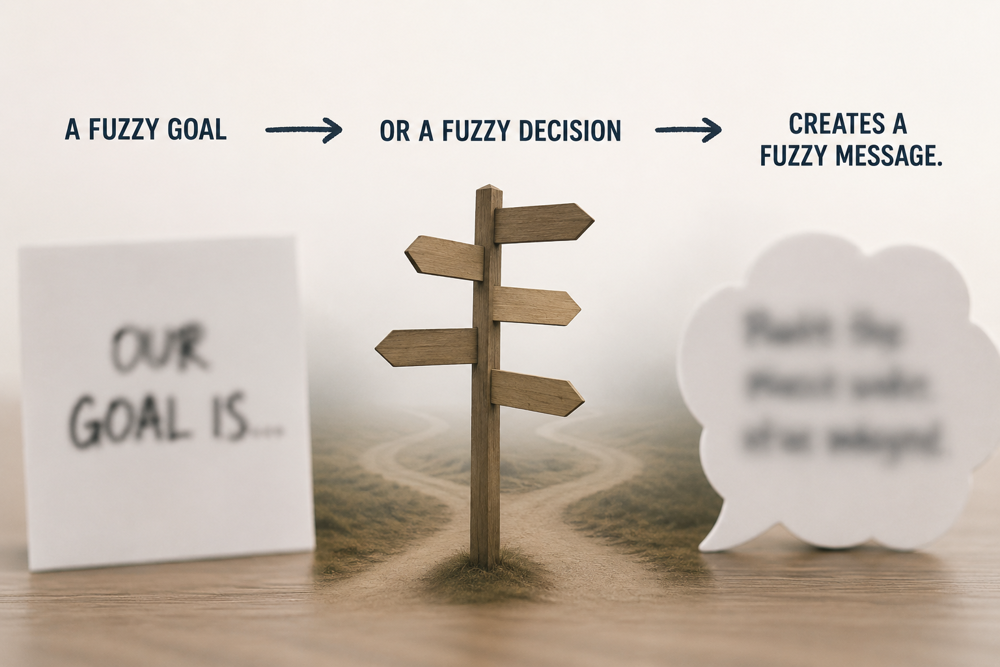
A fuzzy goal, or a fuzzy decision creates a fuzzy message.
A decision with no owner creates polite diffusion (“we” will do it, which means no-one will). And when the senior team aren’t aligned, the organisation does what it always does: it fills the gap with interpretation. It is a human necessity. If the meaning is not clear, we make up our own and often a negative one.
That’s not a comms problem. That’s a leadership hygiene problem.
And here’s the kicker: teams often prefer to call it communication because it feels safer. “Communication” sounds technical. Neutral. Fixable with a workshop and some training.
“Decision failure” sounds personal. It points to avoidance, power dynamics, and the uncomfortable truth that some people like ambiguity because it protects them from accountability.
The facilitator move: close the Decision-to-Delivery gap
The job of a Leader, a Manager or Facilitator isn’t to make meetings more talkative. It’s to make them more decisive.
The practical pattern to watch for is when Teams leave meetings with:
→ A vague intention (“we should…”) rather than a decision.
→ No named owner.
→ No deadline.
→ No definition of “done”.
Then they blame “communication.”
If you can intervene at the point of maximum leverage: the last ten minutes of the meeting.
Not with a lecture. With a repeatable micro-process that forces clarity.
A 30-minute intervention: the Decision Debrief
This is one of those simple tools that feels almost too basic until you see how rarely teams do it.
At the end of the meeting (or at the end of each major agenda item), run a 'Decision Debrief'. Thirty minutes if you’re doing it for the first time; ten minutes once it becomes habit.
Ask five questions. Capture the answers where everyone can see them.
1) What did we decide?
Not “what did we discuss?” Not “what are we thinking?” A decision is a sentence you can disagree with. If you can’t write it down clearly, you don’t have one.
2) Who owns it?
One name. Not a department. Not a committee. Not “we”. If you need multiple people, name a single accountable owner and list contributors.
3) What does “good” look like?
This is where most teams fall apart. Define the outcome in plain terms. What will exist that doesn’t exist today? What will be different in behaviour, process, or result?
4) What’s the first step in the next 72 hours?
This is the anti-procrastination question. It turns a decision into movement. If nothing happens in the first three days, the decision quietly dies.
5) What might block us — and how will we handle it?
This is where you make the team speak up about reality. You’re not asking them to be optimistic. You’re asking them to be prepared. When teams do this well, “communication problems” mysteriously reduce. Because there’s less to interpret.
The phrase that gets you there (without sounding like the accountability police)
Sometimes you need a line that resets the room without making people defensive.
Try:
“Before we move on, let’s check: do we have a decision? Or was that just a discussion we all enjoyed?”
It’s light, but it lands. Or, if you want it even cleaner:
“Who is doing what by when?”
If the room can’t answer quickly, you’ve found the problem.
Why a communication style tool helps here
Even when the process is clear, decision failure often shows up as style conflict. One person pushes hard; another withdraws. Someone interprets directness as aggression. Someone interprets caution as obstruction. People start managing each other’s feelings instead of managing the decision. This is where a communication style inventory earns its keep.
A good tool gives the team a shared language for how they’re landing especially under pressure. It helps people separate intent from impact.
Instead of: “You’re bulldozing.”
You get: “When you go direct and fast, I go cautious and quiet. Here’s what I need to stay in the conversation.”
That’s not therapy. That’s practical facilitation.
And because these tools are low-friction (cheaper than a half-day workshop, more useful than another slide deck) they are without a doubt worth a try.
Tool to deploy
If you want to make this real next week, pair the Decision Debrief with a communication style diagnostic.
Use it when a team keeps revisiting the same decisions. People leave meetings with different interpretations. Delivery is patchy and everyone blames “communication”.
Watch out for labelling. Don’t let it become labelling (“Oh, that’s just how I am”). Keep translating styles back into meeting behaviours: how we decide, how we disagree, how we commit.
Next step
Run a Decision Debrief at the end of your next meeting. Timebox it. Capture the five answers. Then watch what happens to “communication”.