.png)
Imagine... You’re in a glass-walled meeting room that was meant to be “a quick catch-up”.
The M.D. (Mark) is sat forward, elbows on the table, doing that half-smile that says I’m listening while their foot taps under the chair.
The People Director (Helen) has a notebook open, pen poised, and the expression of someone who has said the same thing three different ways already.

Mark: We’re flat out. Order book’s decent. The factory’s running. Customers are shouting. We don’t need a philosophy lecture - we need output.
Helen: I’m not here to give you a lecture. I’m here because we’re paying for that “flat out” twice.
Mark: What does that even mean?
Helen: It means we’re busy, but we’re not moving. We’re burning hours on activity that doesn’t convert into predictable delivery.
Mark: We’re in manufacturing supplying construction. It’s always messy. Variations, late changes, site issues, procurement games - you know the drill.
Helen: I do. And I’m not pretending we can control the market. I’m saying we’re adding our own mess on top.
Mark: Such as?
Helen: Such as the constant reprioritising. Every week it’s a new “this is the most important job”. Supervisors are firefighting, planners are re-planning, and the shop floor is getting whiplash.
Mark: That’s just being responsive.
Helen: It’s being reactive. There’s a difference. Responsiveness is: “We’ve got a clear plan and we adapt it.” Reactivity is: “We don’t have a shared plan, so whoever shouts loudest wins.”
Mark: Customers do shout loudest. That’s the industry.
Helen: And internally, it’s starting to sound the same. People are learning that escalation works better than problem-solving.
Mark: That’s a stretch.
Helen: Is it? Last month we had three supervisors come to me separately and say, “I don’t know what good looks like anymore - just tell me what you want me to do today.”
Mark: They’re supervisors. They should be able to handle pressure.
Helen: They can handle pressure. What they can’t handle is ambiguity that changes daily.
Mark: I’m not trying to be ambiguous. I’m trying to keep us afloat.
Helen: I know. But from their side, it’s not landing as “keeping us afloat”. It’s landing as: “The goalposts move, and if it goes wrong, it’s on me.”
Mark: That’s not fair.
Helen: It might not be fair. It might also be true.
Mark: Look - my dashboard is simple. On-time delivery, quality, cash, customer complaints. If those are under control, we’re fine.
Helen: And my dashboard is: absence, attrition, grievances, capability gaps, and the quality of our supervisors. If those are under control, we’re fine.
Mark: Exactly. Two dashboards.
Helen: Except they’re not separate dashboards. They’re the same dashboard, just lagging and leading indicators.
Mark: Go on.
Helen: When we’re unclear at the top, it shows up as rework and late jobs on your dashboard. It also shows up as stress behaviours on mine - short tempers, blame, people going quiet in meetings, “I’m not sticking my neck out” decisions.
Mark: People are always stressed in this sector.
Helen: Yes - but not all stress is equal. There’s “we’ve got a tough job to do” stress, and there’s “I don’t trust the system or the leadership” stress.
Mark: That’s dramatic.
Helen: It’s not dramatic when it turns into cost.
Mark: What cost?
Helen: The hidden ones you don’t see on the P&L line-by-line:
- Rework cost because teams interpret priorities differently.
- Decision latency because nobody wants to be the person who makes the wrong call.
- Supervision overhead because managers have to chase basics.
- Escalation culture because people learn that shouting beats thinking.
- Attrition risks because our best people get tired of pushing uphill.
Mark: We’re not losing that many people.
Helen: Not yet. But we’re losing the wrong kind of people - the ones with options.
Mark: You’re saying this is a leadership problem.
Helen: I’m saying it’s a direction and credibility problem. People don’t need more posters. They need clarity they can trust.
But we’ve told them the plan.
Mark: We’ve told them the plan. We’ve got the targets. We’ve got the KPIs. We’ve got the weekly ops meeting.
Helen: You’ve told them a plan. They don’t experience it as the plan.
Mark: What’s the difference?
Helen: The difference is whether the plan survives contact with a bad week.
Mark: Meaning?
Helen: Meaning: when a customer screams, when a job goes wrong, when a subcontractor changes the spec do we revert to panic and blame, or do we hold the line on priorities and solve problems like adults?
Mark: We solve problems.
Helen: We solve today’s problems. We don’t always build tomorrow’s capability.
Mark: So what are you actually proposing?
Helen: I’m proposing we stop guessing. We diagnose what’s missing in leadership not in personality terms, but in practical terms: clarity, credibility, communication, empowerment, and the ability to keep people aligned over time.
Mark: Sounds like another HR initiative.
Helen: It’s not an HR initiative. It’s an execution initiative.
Mark: And you think an assessment is going to fix late deliveries?
Helen: No. I think it will tell us why we keep paying for the same problems in different disguises.
Mark leans back. Not convinced. But listening.
Mark: Alright then. Show me how this links to output - not feelings.
Helen: Deal. But we’re going to have to talk about feelings anyway because that’s where commitment lives.

There’s a silence. And not the thoughtful kind. The kind where both are deciding whether to push or retreat.
And you, as the facilitator in the room, notice the real headline: nobody is arguing about leadership. They’re arguing about identity. You can feel both of them doing the same mental math:
• Mark is calculating throughput, margin, customer pain, and operational risk.
• Helen is calculating stress load, capability, retention risk, and how long the middle layer can keep absorbing the shock.
The same problem, two different dashboards
This is the moment a good facilitator doesn’t rush to “solutions”. They name what’s happening in the room because what’s happening in this room is what’s happening in the whole business. These two just don’t see that yet.
Here’s the painfully recognisable and very common question: when the Directors are wobbling and their direct reports are under-trained, do you fix the definition, the inspiration, the people issues, or the performance levers first?
On the surface, it’s a prioritisation debate. Underneath, it’s a collision of threat, trust, and unspoken politics.
- Threat: The M.D. feels the business slipping. When progress slows, the nervous system goes straight to control: tighten, push, demand.
- Identity: HR is protecting the organisation’s social fabric. When attrition rises and engagement drops, their nervous system goes to safety: stabilise, clarify, reduce friction.
- Misaligned expectations: The M.D. expects the other Board Directors to “just step up”. HR expects the organisation to teach leadership, not assume it.
- Conflict avoidance: The senior team has likely learned to keep things polite. So, the real feedback travels sideways (corridor conversations) instead of up & down (direct, courageous dialogue).
- Bias and blind spots: Some leaders are fixed in their behavioural approach: my behaviour is fine; other people are the problem. Others are under-confident and over-accommodating. Both create friction.
- Politics and history: Friendships, old loyalties, personal friction between leaders. The stuff that never appears on the org chart while driving most, if not all, of the decisions.
You may be thinking that the four “problems” they have named, probably without realising (definition, inspiration/alignment, people issues, performance levers), are not separate problems to be prioritised and picked off one at a time.
They’re four symptoms of the same broken system: Inconsistent leadership behaviour, which shows up as culture drag and performance drag through low shared clarity, low self-awareness and high stress
Your next move is not to pick a side. Your move is to make the broken system visible, without shaming anyone.
Then you ask some questions to force specificity and comparison:
You start by saying
Facilitator (you): How about we pause for a second? You are probably describing the same problems from two angles.
The boss raises an eyebrow.
Mark: Go on.
Facilitator: Mark, you’re describing the cost of misalignment rework, late jobs, firefighting, escalation, decision delays.
Helen, you’re describing the human experience of misalignment - uncertainty, silence in meetings, blame, people protecting themselves, supervisors asking for “today’s answer” because they don’t trust that tomorrow won’t change.
Helen nods. Mark looks unconvinced. Still he is listening.
Facilitator: Here’s the link. When senior leaders don’t consistently demonstrate what Sashkin and Rosenbach call visionary leadership behaviours, the business doesn’t just feel “a bit flat”. It becomes expensive. Not because people are weak. It is because the system is asking them to perform without the conditions that make performance sustainable.
What it feels like (and why that matters)
Facilitator: Under pressure we are more likely to live out of our felt experience and when we feel frustrated, annoyed or undermined we do live out those feels we tend to produce poor results.
Think of your Directors and their direct reports. Your “Senior Team” who says... We’ve got too many priorities. Everything’s urgent. Can we just get through this week before you load on more? Can we please stop changing our minds!
And they tell you. You explain those words and phrases reveal their felt experience of a weak FOCUS.
Then you ask: Who says things like, I didn’t realise that’s what you meant. I never said that. That’s not what I heard. Let’s take that offline or can we pick that up later and they never do?
And they tell you. You explain those words and phrases reveal their felt experience of a weak COMMUNICATION
Then you ask: “Who says things like, that’s above my pay grade. I’ll have to check with X, “We can’t make a decision without Y, I am not sure we can trust X with that!”
And they tell you. You explain those words and phrases reveal their felt experience of a weak EMPOWERMENT
Then you ask: “Who says things like, we can’t afford to get this wrong. Let’s not rock the boat. We need more data. We tried that once.”
And they tell you. You explain those words and phrases reveal their felt experience of a weak approach to RISK TAKING
The translation of what you’ll hear people say is the gold:
- Results good or poor show up in the P&L
- Competency, and especially the lack of it, shows up in what people say and do out of their felt experience
The expressions you’ll hear (and feel) in those stressed situations can be mapped to the missing traits. You can use them as diagnostic breadcrumbs.
Facilitator: Let me describe what I see in organisations like yours when the leadership behaviours aren’t consistent and you tell me if it’s familiar.
- Meetings where people wait to see what the MD thinks before they speak.
- A lot of “just tell me what you want” instead of “here’s what I recommend”.
- Managers who over-control, because they don’t trust others to make the right call.
- Managers who under-control, because they’re tired of being blamed.
- A culture of escalation: the fastest route to action is volume, not clarity.
- Good people going quiet not because they don’t care, but because they’ve learned it’s safer.
Mark shifts in his seat.
Mark: That’s… uncomfortably accurate.
Helen: That’s what I’ve been trying to say.
Facilitator: Exactly. And here’s the bit that usually lands for MDs: those behaviours aren’t “soft”. They are the mechanics of execution from a negative felt experience.
When people don’t have clarity they trust, they hedge. When they don’t feel credible leadership, they second-guess. When they don’t feel empowered, they escalate. When they don’t feel cared for or respected, they comply but they don’t commit.
And that’s how you end up with a business that is busy but not moving.
The model gives you a shared language (instead of two competing stories)
Facilitator: The reason I like the Visionary Leadership model is that it stops this becoming a debate between “operations” and “people”.
It gives you a way to connect:
- Observed leadership behaviours (what leaders actually do day-to-day)
- The felt experience (what it’s like to work here when pressure hits)
- The business outcomes (delivery, quality, speed of decision, retention, customer confidence)
Mark, you’ve been looking at the outcomes.
Helen, you’ve been looking at the experience.
The model forces us to look at the behaviours that sit in the middle - because that’s the lever you can actually pull.
Mark exhales.
Mark: So you’re saying my “late delivery problem” and her “supervisor stress problem” are the same thing wearing different clothes.
Facilitator: That’s exactly what I’m saying.
Helen smiles - not smugly. Relieved.
Helen: Finally.
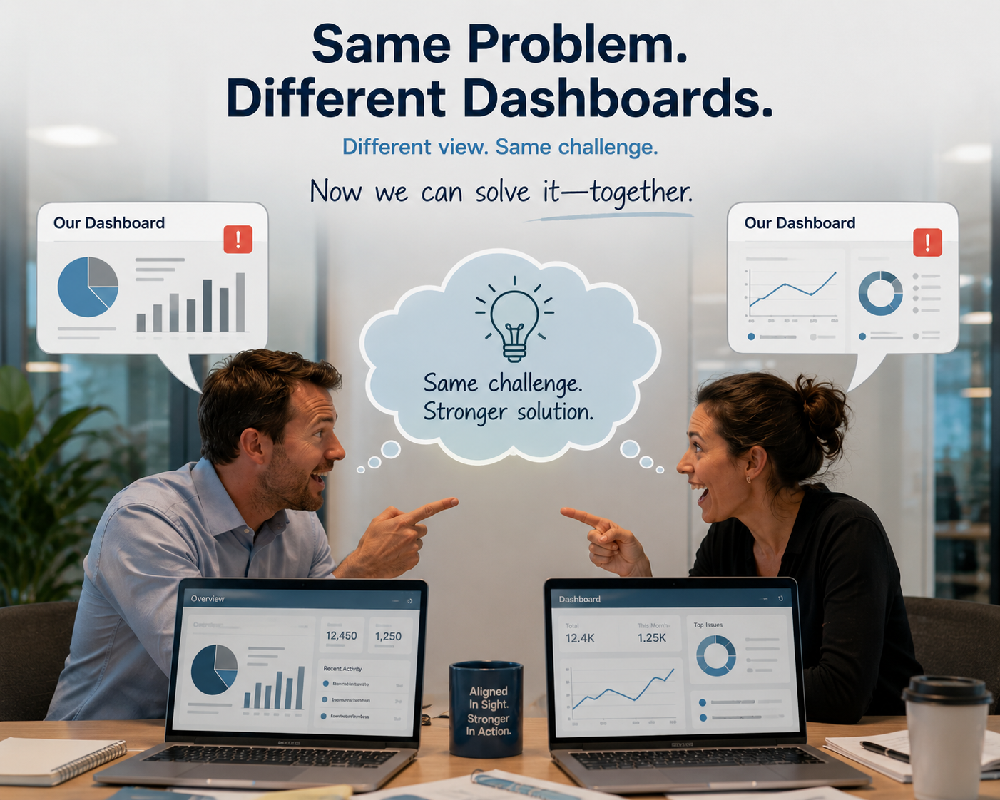
Facilitator: And the good news is: if we can diagnose which visionary leadership behaviours are strong and which are inconsistent, we can stop guessing. We can build a development plan that improves the human experience and the operational outcomes - because they’re linked.
That’s where an assessment becomes useful: not as a label, but as a map. The point is not to diagnose personalities. It’s to create a shared map of leadership behaviour that everyone can agree is real. Two people cannot go on a journey unless they agree the destination and direction let alone a Team. Each person can use self-assessment and 360s to find their own starting point. Each person can find their own path to head in the same direction toward that shared destination.
Then you land the logic the M.D. will respect:
Characteristics → Behaviours → Organisational impact.
If you can’t name the behaviours, you can’t change the impact. If you can’t see the impact, you’ll keep arguing about whose fault it is.
If the above case study (names changed to protect the innocent) resonates with you consider deploying these tools
The Visionary Leader - Use the Self Questionnaire (50 items) to get a baseline, and the Other Questionnaire (360 feedback) when you need reality to enter the chat without you becoming the messenger.
Use it when…
You’ve got a group of Directors whose direct reports (usually managers of others) are under-trained, and you’re seeing / hearing the negative felt experiences signals:
- stalled progress and poor utilisation
- rising frustration and “edge” in conversations
- engagement wobble and early attrition signals
- inconsistent leadership standards (too aggressive / too timid)
Watch-outs…
- Run the 360 to find each person’s pathway not as a punishment. If someone thinks this is a tribunal, they’ll game it or wreck it.
- No sheep-dipping. The same debrief for everyone is lazy and leaders can smell it. Each person needs to find their own start point and their own pathway.
- Do not weaponise the data. If scores become ammunition or fuel for a fight, trust dies instantly.
- You need a conscious agreement with each person on: purpose, confidentiality, and what will happen after the feedback.
What to do now?
If you’re an independent facilitator/coach: talk to us and we can help you test-run The Visionary Leader with one team next week - self first, then 360 where it’s needed.
If you’re in HR/L&D: if you want help choosing the right tool for your context, ask. We’ll point you to best fit without pushing you into a programme you don’t need.
And I’ll leave you with the question that decides whether this lands or becomes another folder on the shared drive: