.png)
One of your managers or clients emails or calls you “We need some training on …”. Insert one of the most common topics, like ‘communication’.
It’s rarely well targeted. It’s just the default setting: something’s not working in the team, so we book a training course. Like buying a new sat nav because the driver keeps ignoring the signs.
And here’s the frustrating bit for us in L&D: you know that you can run a brilliant session and still get no change in behaviour. Not because people didn’t enjoy it, or because the facilitator wasn’t good. Usually because we started with content instead of clarity.
Most “training requests” are not training requests
When someone says “training”, they often mean “please fix this mess without making it awkward”.
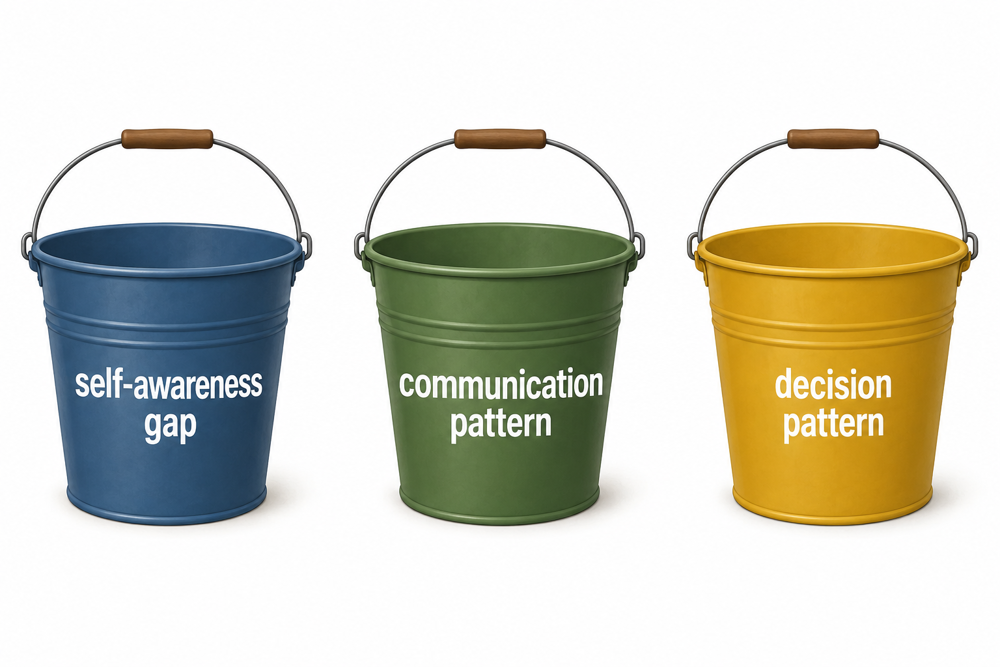 Under the bonnet, most requests fall into one of three buckets:
A self-awareness gap: people don’t see their impact. They’re baffled by the reaction they get.
A communication pattern: avoidance, over-directness, defensiveness, the classic “I’m just being honest” grenade.
A decision pattern: unclear ownership, fuzzy follow-through, meetings that end with warm feelings and cold action.
If you start with a slide deck, you’re guessing which bucket you’re in. If you start with a diagnostic, you’re not.
That’s why the best facilitators and coaches quietly behave like investigators. They don’t begin with “what shall we teach?” They begin with “what’s actually happening?”
The facilitator’s shift: from teaching to revealing
A good diagnostic doesn’t replace skill-building. It makes skill-building relevant.
In practice, it does three jobs in the room.
First, it creates data people can’t easily argue with. Not “proof” (let’s not pretend humans are spreadsheets), but enough signal to stop the conversation being purely opinion.
Second, it normalises difference. When people can see that others genuinely process, decide and communicate differently, it becomes safer to talk about friction without turning it into a character assassination.
Third, it points to specific behaviours you can practise. That’s the gold. Not “be a better communicator”, but “when you’re under pressure, you interrupt; when you’re under pressure, you go quiet; here’s what we’ll do instead.”
The trap is using a profile as a label. The win is using it as a mirror.
Why “type talk” kills momentum
You’ve seen it. The group discovers a framework and immediately starts trading identity stickers.
“I’m a red, so that’s why I’m blunt.” “She’s a blue, so she’ll always overthink it.”
Congratulations: you’ve turned a development session into a horoscope. The point of a diagnostic isn’t to explain people away. It’s to help them notice themselves in time to choose a different behaviour.
So as facilitator we must keep dragging the conversation back to usefulness:
- “What does that look like in a meeting?”
- “What’s the upside of that style?”
- “What’s the cost when it’s overused?”
- “What do you want to do differently next time?”
A simple 60-minute debrief session flow (that avoids the swamp)
If you want a clean, repeatable structure that works with most inventories, try this:
1) Contract (5 minutes)
Say it plainly: “This is a starting point, not a verdict.” You’re lowering defensiveness before it starts.
2) Spot the upsides (10 minutes)
Ask: “When is this style an advantage?” This stops the room turning into a public therapy session and keeps dignity intact.
3) Name the costs (10 minutes)
Ask: “When does this create friction?” Not “what’s wrong with you?” but “where does this get expensive?”
4) Translate to behaviours (20 minutes)
Ask: “What do we need more of and less of in meetings?” Now you’re in observable territory: interrupting, hedging, rescuing, avoiding, dominating, checking out.
5) Agree one experiment (15 minutes)
Ask: “What will we try for the next two weeks?” Two weeks is short enough to feel doable and long enough to create evidence.
This is where you turn insight into movement.

What to do when someone resists the tool
There’s always one. Sometimes they’re sceptical. Sometimes they’re anxious. Sometimes they’ve been “assessed” to death. Don’t wrestle them into compliance. That just makes you the problem.
Try this instead:
“You don’t have to agree with every line. I’m primarily interested in what this inventory helps you notice.”
That sentence does three things:
- It gives them autonomy.
- It lowers the stakes.
- It shifts the goal from “believing” to “observing”.
Then follow with a behavioural question:
“Where does this show up for you under pressure?”
If they can answer that, you’re back in business.
The real reason diagnostics work: they reduce social risk
Here’s the bit people don’t say out loud. Most teams avoid honest feedback because it’s socially dangerous. If I tell you the truth, will you punish me? Will you sulk? Will you retaliate later? A diagnostic creates a third point in the room. It’s not “me versus you”. It’s “us looking at this data together”.
That doesn’t guarantee maturity, but it gives you a safer starting line.
If you want one diagnostic that works in almost any group
If you’re facilitating mixed teams and you want a practical, non-jargony first lens, start with a broad personal style inventory.
It’s “low-friction” for participants, quick to deploy, and it gives you enough shared language to run a debrief that leads somewhere useful.
And because it’s typically £30 per person, it’s often cheaper than a half-day workshop and more useful than another slide deck that everyone politely forgets.
Next step: buy credits or booklets, run a session, get movement.